


Should curtains touch the floor? In most living rooms, bedrooms, and dining rooms, curtains look best when they reach the floor, lightly touch it, or extend beyond it in a deliberate break or puddle. Floor-length curtains create a polished appearance, make windows look larger, and can help a room feel taller and more complete.
However, curtains do not always need to rest directly on the floor. In busy rooms, homes with pets, children’s bedrooms, or spaces that require frequent cleaning, curtains may work better when they float about half an inch above the surface.
The right answer therefore depends on the room, fabric, floor condition, curtain function, rod height, and desired style.
Curtain terminology also varies slightly among designers and retailers. Some use “kiss,” “graze,” “float,” and “break” differently. For that reason, exact measurements matter more than the name of the style.
| Curtain length | Position | Best use | Main advantage | Main drawback |
| Float | About ½ to 1 inch above the floor | Modern and high-use rooms | Easy to clean and operate | Can expose uneven floors |
| Kiss or graze | Barely touches the floor | Most living rooms and bedrooms | Polished and versatile | Requires precise measuring |
| Break | About 1 to 2 inches on the floor | Relaxed and elegant rooms | Softens the room and hides small floor variations | May catch under furniture |
| Puddle | About 3 to 6 inches on the floor | Formal and decorative spaces | Luxurious and dramatic | Collects dust and needs more care |
| Cafe length | Covers only part of the window | Kitchens, bathrooms, and obstructed windows | Practical privacy solution | Does not create a full-height look |
Should Curtains Touch the Floor in Most Homes?
In most cases, yes. Standard curtain panels usually look more intentional when they reach the floor. Curtains that stop three or four inches above it can appear too short, especially when they hang beside a full-height wall or large window.
Floor-length curtains create a continuous vertical line from the rod to the floor. As a result, they can make the ceiling appear higher and the window look taller.
They also give the room more visual balance. A window often contains hard lines from the frame, wall, glass, and surrounding furniture. Long fabric adds softness and movement.
However, “touching the floor” does not mean every curtain must form a large pool of fabric. A curtain can end just above the floor and still count as a full-length treatment.
The four main options are:
- Floating slightly above the floor
- Barely kissing the floor
- Forming a small break
- Creating a full decorative puddle
The best choice depends on how the curtain will be used.
Why Floor-Length Curtains Usually Look Better
Floor-length curtains often appear more expensive and professionally designed than short standard panels.
They can improve a room in several ways.
First, long curtains make windows appear larger. When the rod sits above the window frame and the fabric extends to the floor, the eye reads the entire curtain area as part of the window.
Second, they can make a small room feel taller. Vertical fabric lines draw the eye upward and reduce the visual break between the window and floor.
Third, they create a more finished look. Even simple curtains can look elegant when they have the correct length and enough fullness.
Floor-length curtains may also improve:
- Privacy
- Light coverage
- Visual warmth
- Acoustic softness
- Draft reduction
- The appearance of wide windows
- The framing of sliding glass doors
Still, length alone does not create complete blackout or insulation. Fabric density, lining, width, and installation also play major roles.
Should Curtains Touch the Floor or Float Above It?
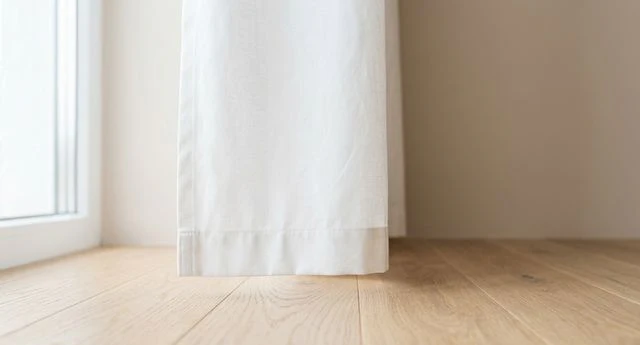
Floating curtains stop slightly above the floor. A gap of approximately half an inch works well in many rooms. Some homeowners prefer up to one inch of clearance.
This style creates a crisp and tailored appearance. It suits contemporary, minimalist, and practical interiors.
Because the curtain does not drag, it stays cleaner and moves more easily. Therefore, a float often works best when you open and close the curtains every day.
Floating curtains are useful in:
- Family living rooms
- Children’s bedrooms
- Nurseries
- Pet-friendly homes
- High-traffic rooms
- Modern offices
- Rooms with robot vacuums
- Spaces that require frequent floor cleaning
However, a floating hem requires careful measurement. If the gap grows much larger than one inch, the curtain may look accidentally short.
A float can also expose an uneven floor. For example, if one side of the floor is lower, the gap may appear wider on that side.
What Does It Mean When Curtains Kiss the Floor?
Curtains that kiss the floor barely touch it. The hem lightly brushes the surface without forming a noticeable fold.
This is one of the most versatile curtain lengths. It creates the appearance of a perfectly fitted curtain without leaving a large amount of fabric on the floor.
A floor-kissing length works well with:
- Blackout curtains
- Sheer curtains
- Linen panels
- Cotton curtains
- Lined drapery
- Single panels
- Double panels
- Sliding-door curtains
It is especially popular in living rooms because it combines elegance with daily practicality.
However, this style requires exact measuring. Even a half-inch difference may change the result from a floor kiss to a visible float or small break.
Measure only after deciding where the curtain rod or track will sit. Also account for rings, hooks, grommets, or other heading hardware.
What Is a Break-Length Curtain?
Break-length curtains extend slightly beyond the floor measurement. Usually, they include approximately one to two inches of extra fabric.
When the curtain reaches the floor, the excess fabric bends gently. This fold is known as the break.
A break gives the curtain a softer, more relaxed appearance than a precise float. At the same time, it remains more practical than a large puddle.
This style works especially well with natural and fluid fabrics, including:
- Linen
- Cotton
- Silk
- Lightweight wool
- Soft fabric blends
Natural fabrics may respond to humidity, gravity, washing, or temperature. Linen, for example, may relax and become slightly longer after hanging. A small break makes these changes less noticeable.
Break-length curtains can also hide minor variations in an uneven floor. Since the hem already touches the surface, a small difference in height does not stand out as clearly.
However, avoid this length when rough flooring, damaged baseboards, nails, or splinters could catch the fabric.
Should Curtains Puddle on the Floor?
Puddled curtains extend several inches beyond the floor. The extra fabric pools decoratively at the bottom.
A standard puddle usually includes about three to six inches of extra length. Some highly formal designs use more, but larger puddles require careful arrangement.
Puddled curtains create a dramatic, romantic, and luxurious appearance. They often suit:
- Formal dining rooms
- Traditional living rooms
- Primary bedrooms
- Decorative sitting rooms
- Historic-style interiors
- Low-traffic spaces
Heavy and luxurious fabrics tend to create the best puddles. Velvet, silk, wool, and substantial linen have enough weight to form rich folds.
However, the puddle must appear deliberate. Curtains that are only slightly too long may look incorrectly measured rather than stylish.
Puddled curtains also need more maintenance. They collect dust, pet hair, and floor debris. They can complicate vacuuming and may need frequent rearranging.
Therefore, they work best as stationary or rarely moved side panels.
Are Puddled Curtains Outdated?
Puddled curtains are not completely outdated. However, they are no longer the default choice for most modern homes.
Contemporary interiors often favor curtains that float, kiss, or lightly break at the floor. These styles look clean and remain easier to maintain.
Puddled curtains still work well in:
- Formal rooms
- Traditional interiors
- Romantic bedrooms
- Luxury homes
- Decorative spaces with little foot traffic
The key is intention. The fabric, room style, and curtain arrangement should support the dramatic effect.
A large puddle in a busy family room may look impractical. By contrast, the same treatment can look elegant in a formal bedroom where the curtains remain mostly stationary.
Should Curtains Touch the Floor in the Living Room?
Living-room curtains usually look best when they reach or nearly reach the floor.
Long panels can make the window look larger and may help a small living room feel more spacious. They also create a comfortable and welcoming atmosphere.
The best living-room length depends on how formal the room feels and how often you move the curtains.
Choose a float when:
- The curtains open and close daily
- You have children or pets
- The room has a modern design
- Easy cleaning matters
- Furniture sits close to the window
Choose a floor kiss when:
- You want a polished universal look
- The floor is level
- You want full length without extra fabric
- The curtains need to remain practical
Choose a break when:
- You prefer a softer look
- The room uses linen or silk
- The floor is slightly uneven
- You want an elegant but relaxed style
Choose a puddle when:
- The living room is formal
- The panels are mostly decorative
- The fabric is heavy or luxurious
- Extra maintenance is acceptable
For most living rooms, a floor kiss or small break offers the best balance.
Should Curtains Touch the Floor in the Bedroom?
Bedroom curtains should generally reach the floor. Long curtains can make the room feel calmer, softer, and more private.
A floor-length design also works well with blackout lining because it reduces the visible gap beneath the curtain.
However, curtain length alone does not guarantee darkness. Strong blackout performance also depends on:
- Fabric density
- Blackout lining
- Curtain width
- Side coverage
- Rod placement
- Gaps above the curtain
- Layered blinds or shades
In a primary bedroom, a small break or puddle can create an elegant look. In a child’s bedroom, a float is usually safer and easier to maintain.
A floor-kissing hem works well for most standard bedrooms because it provides full visual length without creating much fabric on the floor.
Should Curtains Touch the Floor in a Dining Room?
Dining rooms often suit curtains that touch or extend slightly onto the floor.
A small break can add softness and elegance. Linen and silk work especially well because they form natural, flowing folds.
A formal dining room may also suit a puddled curtain, particularly when the panels remain decorative.
However, consider nearby furniture. Curtain fabric may catch beneath:
- Dining chairs
- Sideboards
- Cabinets
- Table legs
- Decorative furniture
When furniture stands close to the window, a floor kiss or float may offer a cleaner result.
Should Curtains Touch the Floor in the Kitchen?
Full-length curtains do not suit every kitchen.
Curtains near sinks, countertops, food-preparation areas, or heat sources may become dirty or unsafe. Moisture and cooking residue can also affect the fabric.
Shorter options often work better for windows above counters. These include:
- Cafe curtains
- Roman shades
- Roller shades
- Blinds
- Short tailored panels
However, floor-length curtains may still work beside a kitchen patio door, breakfast area, or dining nook.
Before choosing long curtains, consider:
- Distance from the stove
- Distance from the sink
- Foot traffic
- Floor-cleaning needs
- Pets and children
- Nearby doors
- Moisture levels
Therefore, the answer depends more on the window position than on the room name.
Should Curtains Touch the Floor in a Bathroom?

Bathrooms often benefit from shorter, moisture-resistant window treatments.
Long curtains may absorb humidity, touch damp flooring, or create a trip hazard in a small space.
Cafe curtains work well because they provide privacy while allowing light through the upper part of the window.
Blinds and shades may also offer easier maintenance.
However, full-length curtains can work in a large, well-ventilated bathroom when the window is far from the shower, bathtub, sink, and main walking path.
Choose washable or moisture-tolerant fabric and avoid allowing the hem to remain on a damp floor.
Should Curtains Touch the Floor Near a Radiator?
Curtains should not block a radiator or other heat source.
Long curtains can trap heat behind the fabric, reduce airflow, and increase safety concerns. The material may also become discolored or damaged over time.
When a radiator sits below the window, consider:
- Cafe curtains
- Roman shades
- Roller shades
- Blinds
- Curtains ending above the radiator
- Side panels that remain away from the heat source
Always follow the heater or radiator manufacturer’s clearance instructions.
Practical safety should take priority over the general rule that curtains should reach the floor.
Should Curtains Touch the Floor Around Sliding Doors?
Floor-length curtains often look attractive around sliding glass doors. They frame the opening and create visual height.
Single-panel and double-panel designs can both work. However, the curtains should move freely without becoming trapped in the door.
A float or floor-kissing length usually works best because it avoids excess fabric in the walking path.
Consider:
- Door movement
- Handle placement
- Daily foot traffic
- Pets using the door
- Outdoor dirt
- Curtain stacking space
- Furniture near the opening
A puddle is rarely practical beside a frequently used sliding door.
Should Sheer Curtains Touch the Floor?
Sheer curtains usually look best when they reach the floor.
A floor kiss or small break gives sheer panels a soft and graceful appearance. Because sheer fabric is lightweight, it may move with air from fans, vents, and open windows.
Therefore, a precise floor kiss may occasionally brush the surface, while a float can stay cleaner.
Sheers also need sufficient fullness. Panels that are too narrow may look flat and provide limited privacy.
In many cases, sheer curtains look best at approximately two to two and a half times the width of the area being covered.
Should Blackout Curtains Touch the Floor?
Blackout curtains should generally reach the floor or come very close to it.
Longer coverage can reduce the gap at the bottom and may improve room darkening. However, it will not remove every light leak.
For better results:
- Mount the rod above the window
- Extend the rod beyond both sides
- Use wide panels
- Add blackout lining
- Consider curtain returns
- Layer curtains with a blackout blind or shade
A float may still work well when it leaves only a small gap.
A break can provide additional low-level coverage, but it may collect more dust.
Should Linen Curtains Touch the Floor?
Linen curtains often look best with a floor kiss or small break.
Linen has a natural, relaxed appearance. It may also change slightly due to humidity, gravity, and cleaning.
A precise float can become difficult to maintain if the fabric relaxes after installation. Therefore, a break of one or two inches can make small changes less noticeable.
A light puddle can also work in a formal room, although linen may continue to relax over time.
Always check whether the fabric is pre-washed and follow the care instructions before final hemming.
Should Velvet Curtains Touch the Floor?
Velvet curtains can kiss, break, or puddle on the floor.
Because velvet is thick and heavy, it creates rich folds and works especially well in formal interiors.
A puddle can look luxurious, but velvet also collects dust and pet hair. Consequently, extra fabric on the floor increases maintenance.
For a more practical look, choose a floor kiss or small break. These lengths preserve the fabric’s richness without creating a large pool.
How Fabric Affects Curtain Length
Different fabrics behave differently after installation.
Synthetic fabrics often hold their dimensions well. Therefore, they usually suit precise float or floor-kissing lengths.
Natural fabrics may stretch, shrink, or relax.
| Fabric | Recommended length | Main consideration |
| Polyester | Float or floor kiss | Usually stable and easy to maintain |
| Performance fabric | Float or kiss | Practical for active homes |
| Linen | Kiss, break, or light puddle | May relax or change with humidity |
| Cotton | Kiss or break | May shrink after washing |
| Silk | Break or puddle | Elegant but delicate |
| Wool | Kiss or break | Can create a structured drape |
| Velvet | Break or puddle | Luxurious but collects dust |
| Sheer fabric | Float, kiss, or break | Lightweight and affected by airflow |
Always confirm the cleaning method before choosing the final hem.
Should Curtains Touch the Floor With Children or Pets?
Homes with children or pets usually benefit from floating or floor-kissing curtains.
Excess fabric can create several problems. Children may pull, sit on, or trip over a puddle. Pets may scratch, chew, or sleep on it.
Long fabric may also collect:
- Pet hair
- Dirt
- Food crumbs
- Toy debris
- Dust
- Outdoor particles near doors
A float keeps the full-length appearance while reducing contact with the floor.
Also make sure the curtain rod and brackets are securely anchored. A child pulling on the fabric can place significant force on the hardware.
Should Curtains Touch the Floor for Older Adults?
A float is often the safest full-length option in homes with older adults or people with limited mobility.
Break-length and puddled curtains may create a trip hazard, especially near:
- Doors
- Narrow walkways
- Beds
- Seating areas
- Frequently used windows
A half-inch gap preserves the visual effect of a long curtain while keeping fabric away from feet and mobility aids.
How High Should You Hang Curtain Rods?
The rod position directly affects the final curtain length.
Mounting the rod above the window frame can make the window appear taller. Extending it beyond the sides can make the window look wider and allow more glass to remain visible when the curtains are open.
The exact rod height depends on:
- Ceiling height
- Window size
- Crown molding
- Curtain heading
- Rod thickness
- Furniture
- Desired light level
- Available wall space
In many rooms, the rod can sit between the top of the window and the ceiling. However, no single measurement works in every home.
With very high ceilings, placing the rod around eight to ten inches above the frame may create balanced proportions. Treat this as an example rather than a universal rule.
Choose the rod position before measuring or ordering curtains.
How to Measure Curtains That Touch the Floor
Accurate measuring prevents curtains from looking too short or accidentally long.
First, decide where the rod or track will sit. Next, determine where the curtain begins. The measurement may start from:
- The bottom of a curtain ring
- The eye of a ring
- A hook position
- The top of a track
- The top of a rod
- The bottom of a grommet
Then measure vertically to the floor using a steel tape measure.
Use these general adjustments:
- Float: subtract about ½ inch
- Larger float: subtract up to 1 inch
- Floor kiss: use the exact measurement
- Break: add about 1 to 2 inches
- Puddle: add about 3 to 6 inches
Measure the left, center, and right sides of the window. Floors are not always level.
When the measurements vary, choose the final length according to the style:
- For a float, use the shortest safe measurement
- For a floor kiss, consider custom hemming
- For a break or puddle, use the extra fabric to hide small differences
Measure twice before ordering.
Should You Measure From the Window or the Rod?
Measure from the actual curtain rod, track, ring, or hook position rather than from the top of the window frame.
The curtain does not begin at the window frame unless the hardware sits exactly there.
Measuring from the wrong point can create a large length error.
Also account for the heading style. Grommet curtains, rod pockets, pleated curtains, and ring-hung panels all sit differently on the rod.
How Wide Should Curtains Be?
Curtain width affects the finished appearance as much as length.
Panels need enough fabric to form folds when closed. Otherwise, even perfectly measured curtains may look flat and unfinished.
A common fullness range is approximately two to two and a half times the width of the rod or track.
For example, if the rod measures 100 inches, the combined curtain width may need to measure between 200 and 250 inches.
The ideal fullness depends on:
- Fabric thickness
- Heading style
- Desired privacy
- Sheerness
- Pattern
- Whether the curtains close
- Decorative preference
Sheer fabric often needs more fullness. Heavy velvet may need less because each fold uses more space.
Can Curtains Be Too Long?
Yes. Curtains are too long when the excess fabric looks accidental or creates practical problems.
Signs that curtains are too long include:
- Random bunching
- Uneven folds
- Fabric trapped beneath furniture
- Difficulty opening the panels
- Dirt along the hem
- Trip hazards
- Fabric blocking a vent or radiator
- Panels catching in a door
Extra fabric should create an intentional break or puddle. Otherwise, the curtains may need hemming.
Can Curtains Be Too Short?
Yes. Standard panels often look too short when they end several inches above the floor.
A gap of half an inch to one inch can look intentional as a float. A much larger gap usually creates an unfinished appearance.
However, intentionally short curtains can work in specific situations.
These include:
- Cafe curtains
- Kitchen windows
- Bathroom windows
- Windows above radiators
- Windows above shelves
- Windows above counters
- Small traditional windows
The proportions should clearly show that the shorter length is part of the design.
When Cafe Curtains Are a Better Choice
Cafe curtains cover the lower portion of a window while leaving the upper section exposed.
They provide privacy without blocking all natural light.
Cafe curtains work especially well in:
- Kitchens
- Bathrooms
- Breakfast rooms
- Traditional interiors
- Country-style homes
- Double-hung windows
- Windows above countertops
- Rooms with radiators
Unlike accidentally short panels, cafe curtains look intentional because their placement, hardware, and proportions support the design.
Do Floor-Length Curtains Improve Privacy?
Floor-length curtains can improve privacy because they cover more of the wall and window area.
However, privacy also depends on:
- Fabric opacity
- Curtain width
- Gaps between panels
- Side coverage
- Time of day
- Interior lighting
- Window position
Sheer floor-length curtains may provide daytime privacy but limited privacy at night when indoor lights are on.
For stronger privacy, combine sheers with lined curtains, shades, or blinds.
Do Floor-Length Curtains Block More Light?
Curtains that reach the floor can reduce the light gap at the bottom. Break and puddle lengths provide slightly more coverage than a float.
Still, the biggest light leaks usually occur at the sides and top of the window.
For better light control:
- Use blackout fabric or lining
- Extend the rod beyond the window
- Mount the rod high
- Choose wide panels
- Add side returns
- Layer with a shade or blind
Therefore, curtain length helps, but it does not determine blackout performance by itself.
Do Floor-Length Curtains Improve Insulation?
Floor-length curtains may reduce airflow around the lower part of a window.
Lined curtains can also create an additional barrier between the glass and the room.
Insulation depends on:
- Fabric thickness
- Lining
- Curtain width
- Distance from the wall
- Coverage at the top and sides
- Window condition
- Whether the curtain blocks a heater
Do not allow curtains to cover radiators, heating units, or ventilation openings.
How Floor Condition Affects Curtain Length
Check the floor before choosing a curtain length.
A float works best on a level floor because the visible gap creates a straight horizontal line.
A break or puddle can hide small floor variations. However, the fabric may become damaged if the surface contains:
- Splinters
- Rough wood
- Protruding nails
- Broken tiles
- Sharp edges
- Damaged baseboards
Repair the floor or choose a float when the surface could snag the material.
How Furniture Placement Affects Curtain Length
Furniture can interfere with curtains that touch the floor.
Break-length and puddled panels may become trapped beneath:
- Sofas
- Chairs
- Tables
- Cabinets
- Beds
- Desks
When furniture stands directly in front of the window, the floor treatment may also remain hidden.
In that case, a float or floor kiss often makes more sense.
Allow enough space for the panels to open, close, and stack without rubbing against furniture.
Common Curtain-Length Mistakes
Several mistakes can make curtains look poorly fitted.
One common mistake involves buying curtains before choosing the rod height. This may force you to install the rod too low simply because the panels are short.
Other mistakes include:
- Measuring from the window frame instead of the rod
- Ignoring rings, hooks, or grommets
- Leaving a large accidental gap above the floor
- Using a precise float on an uneven surface
- Creating a puddle in a high-traffic room
- Allowing curtains to cover a radiator
- Choosing too little curtain width
- Ignoring fabric shrinkage
- Letting fabric drag across damaged flooring
- Placing excess fabric near a sliding door
- Forgetting cleaning and pet-hair concerns
Planning the rod, width, heading, fabric, and length together produces the best result.
What Is the Best Curtain Length?
For most homes, the best curtain length is either a floor kiss or a small break.
A floor kiss looks polished and remains practical. A break adds softness and handles small floor or fabric changes more easily.
Choose a float when cleaning, safety, pets, or frequent movement matter most.
Choose a puddle only when you want a formal decorative effect and can accept the extra maintenance.
Frequently Asked Questions About Should Curtains Touch the Floor
Both options can look correct. Curtains that touch the floor create a polished appearance, while curtains floating up to one inch above it stay cleaner and move more easily.
Yes. Living-room curtains usually look best when they kiss the floor, form a small break, or float slightly above it.
Floating curtains should usually sit about half an inch above the floor. A gap of up to one inch may also look intentional.
Curtains can barely kiss the floor, form a one-to-two-inch break, or create a three-to-six-inch puddle.
A floor-kissing length is one of the most popular choices because it looks tailored while remaining practical. A small break is also widely used.
Bedroom curtains generally look best when they reach the floor. A float works well in children’s rooms, while a break or puddle can suit a formal primary bedroom.
Blackout curtains should usually reach or nearly reach the floor. However, lining, width, rod placement, and side coverage have a greater effect on light blocking.
Sheer curtains usually look best when they kiss the floor or form a gentle break. A float may work better in rooms that require easy cleaning.
Linen curtains often suit a floor kiss or small break. Since linen may relax over time, a break can make minor length changes less noticeable.
Velvet curtains can kiss, break, or puddle on the floor. A puddle looks luxurious but collects more dust and pet hair.
Not always. Shorter curtains, blinds, or shades may work better above sinks and countertops. Floor-length curtains can still suit patio doors or dining areas.
Usually only when the bathroom is large, well ventilated, and the window sits away from moisture and walking paths.
A float or floor-kissing hem is usually more practical in homes with pets. Puddled curtains may collect fur and dirt.
No, but they are more traditional and formal than float or break lengths. Modern homes often favor cleaner floor-skimming styles.
They can, but a two-inch gap may begin to look accidental. A gap of half an inch to one inch usually creates a more intentional float.
A standard puddle generally uses about three to six inches of extra fabric.
No. Curtains should not block a radiator or heater. Use a shorter treatment or keep the panels safely beside the heat source.
They can, but a float or floor kiss is usually best. Avoid large puddles where people walk through the door frequently.
In most full-length installations, yes. Curtains that reach the floor usually look more polished and make the window appear taller.
Yes. Floating curtains, cafe curtains, kitchen treatments, and curtains above radiators can all look correct when the shorter length is deliberate.
Conclusion
So, should curtains touch the floor? In most living rooms, bedrooms, and dining rooms, curtains should reach or nearly reach it. A floor kiss or small break usually provides the most attractive balance between style and practicality.
However, curtains can float half an inch above the floor in busy rooms, children’s spaces, pet-friendly homes, or places that require frequent cleaning.
Puddled curtains remain suitable for formal and low-traffic interiors, although they collect more dust and require greater care.
Meanwhile, cafe curtains and other shorter treatments work better around countertops, radiators, moisture, and practical obstructions.
Before ordering curtains, decide where the rod will sit, measure from the actual hardware to the floor, check the surface at several points, and consider how the fabric may behave over time. When length, width, material, and installation work together, curtains can make a window look taller and the entire room feel more complete.