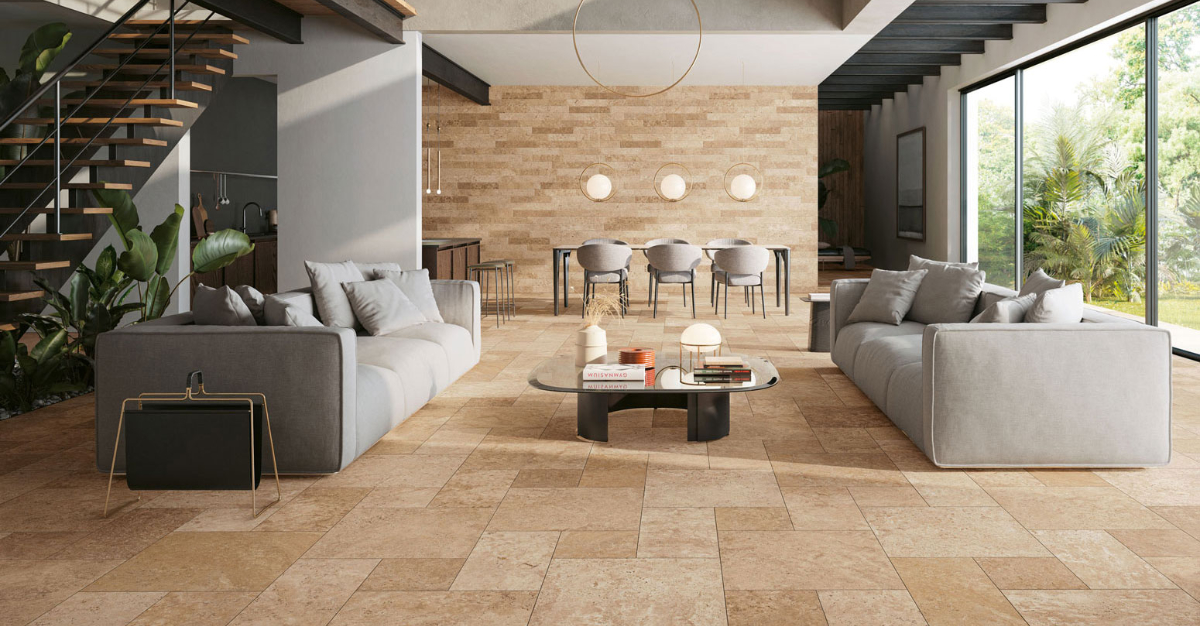

Travertine floor tile is a natural limestone flooring known for its warm colors, visible pores, soft texture, and one-of-a-kind variation. It can create an elegant, rustic, Mediterranean, or modern look, depending on the finish and layout.
It is also more demanding than porcelain or ceramic tile. Travertine can absorb stains, react to acidic cleaners, scratch under heavy abrasion, and require periodic sealing.
For homeowners who appreciate natural stone and do not mind regular maintenance, travertine can be a durable and attractive flooring choice. This guide explains how to choose the right tile, finish, size, pattern, and installation method for your space.
What Is Travertine Floor Tile?
Travertine floor tile is made from travertine, a porous type of limestone formed by mineral deposits around hot springs, springs, and limestone caves.
As the stone develops, water movement and escaping gases create small holes, channels, and cavities. These natural openings give travertine its recognizable appearance.
Manufacturers may leave the holes open or fill them with cement, resin, or another compatible material.
Travertine is sometimes described as marble, but that is incorrect. Travertine is a sedimentary limestone, while marble is a metamorphic stone formed when limestone is transformed by heat and pressure.
Why Is Travertine Flooring Popular?
Travertine remains popular because it combines natural beauty with a wide range of colors, finishes, patterns, and sizes.
Homeowners often choose it for the following reasons:
- Warm, earthy appearance
- Unique color variation
- Natural texture
- Long service life
- Multiple finish options
- Compatibility with traditional and modern interiors
- Availability in tiles, mosaics, trim pieces, and pavers
- Ability to develop an aged patina over time
Unlike printed tile, every piece of natural travertine is different. Some tiles may be lighter, darker, more porous, or more heavily veined than others.
That variation is part of the material’s character rather than a manufacturing flaw.
Travertine Floor Tile Pros and Cons
| Pros | Cons |
| Natural, distinctive appearance | Requires more maintenance than porcelain |
| Warm neutral color palette | Can stain if poorly sealed |
| Available in many sizes and patterns | Sensitive to vinegar, citrus, and acids |
| Suitable for many indoor spaces | May scratch or chip |
| Can last for decades | Color variation can be unpredictable |
| Works with radiant floor heating | Heavy and harder to install |
| Individual tiles may be replaceable | Some finishes become slippery when wet |
| Can develop an attractive patina | Periodic resealing may be needed |
Travertine Floor Tile Colors
Travertine is best known for neutral and earthy shades.
Common colors include:
- Ivory
- Cream
- Beige
- Tan
- Sand
- Honey
- Gold
- Walnut
- Noce brown
- Silver
- Gray
- Rust
- Red-brown
The final color can also change slightly after sealing. Some penetrating or enhancing sealers deepen the natural tone, while other sealers are designed to preserve a more natural appearance.
Always test the selected sealer on a spare tile or inconspicuous area first.
Travertine Tile Grades
Travertine is sometimes sold in different quality grades, although grading systems are not always consistent between suppliers.
You may see descriptions such as:
- Premium
- Select
- Standard
- Commercial
Higher-quality tiles may have:
- More consistent thickness
- Better edge calibration
- Fewer large holes
- Less filler
- More controlled color variation
- Fewer cracks or weak areas
Lower-cost tile may contain more filler, larger voids, greater thickness variation, or less consistent sizing.
Because supplier terminology varies, inspect actual samples instead of relying only on the grade name.
Cross-Cut vs. Vein-Cut Travertine
How the stone block is cut changes the pattern of the tile.
Cross-cut travertine
Cross-cut travertine is sliced across the stone’s natural bedding layers.
It usually has:
- Cloud-like markings
- Circular patterns
- Irregular movement
- A softer, less directional appearance
Cross-cut tile is commonly used in kitchens, living areas, bathrooms, and traditional interiors.
Vein-cut travertine
Vein-cut travertine is sliced parallel to the natural layers.
It often displays:
- Long linear bands
- Strong directional veins
- More architectural movement
- A cleaner, more contemporary look
Vein-cut travertine can visually lengthen a hallway or room when the lines are installed in the same direction.
Travertine Floor Tile Finishes
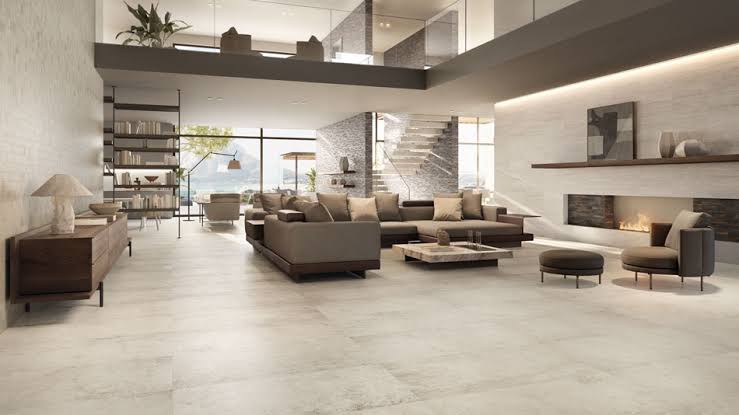
The finish affects appearance, maintenance, traction, and where the tile can be used.
Honed travertine
Honed travertine has a smooth, matte, or low-sheen surface.
It is one of the most practical choices for indoor flooring because it feels refined without becoming highly reflective.
Best for:
- Kitchens
- Living rooms
- Hallways
- Bedrooms
- Dry bathroom areas
Polished travertine
Polished travertine has a glossy and reflective surface.
It can make colors and veining appear richer, but it may also show scratches, etching, and wear more easily.
Best for:
- Formal rooms
- Decorative areas
- Low-moisture spaces
Use caution on wet floors because polished stone may become slippery.
Tumbled travertine
Tumbled travertine has softened edges and an aged, worn surface.
It is often chosen for rustic, old-world, farmhouse, or Mediterranean designs.
Best for:
- Patios
- Pool surrounds
- Entryways
- Rustic kitchens
- Outdoor entertaining areas
Texture does not automatically mean a tile is safe for every wet location. Check the product’s slip and application ratings.
Brushed travertine
Brushed travertine is textured with abrasive brushes.
It has more grip and visual texture than polished stone and is often used in informal or transitional settings.
Filled travertine
Filled travertine has its natural pores filled during manufacturing.
Benefits include:
- Smoother surface
- Easier cleaning
- Less dirt accumulation
- More uniform appearance
Filled and honed travertine is one of the most practical options for indoor flooring.
Unfilled travertine
Unfilled travertine retains its natural cavities.
It offers a highly natural and rustic look, but the holes may collect dirt or debris.
During installation, some open areas may be filled with grout.
Chiseled-edge travertine
Chiseled-edge tile has irregular or hand-worked edges.
It is often used for:
- French patterns
- Rustic interiors
- Mediterranean rooms
- Traditional patios
The uneven edge creates character but requires careful grout-joint planning.
Popular Travertine Floor Tile Sizes
Travertine is available in small mosaics, standard squares, rectangles, and large-format pieces.
Common sizes include:
| Size | Typical use |
| 2 × 2 inches | Shower floors and mosaics |
| 4 × 4 inches | Borders, accents, and small spaces |
| 6 × 6 inches | Small bathrooms and decorative layouts |
| 8 × 8 inches | Traditional floors and patterns |
| 12 × 12 inches | Classic residential flooring |
| 12 × 24 inches | Modern linear layouts |
| 16 × 16 inches | Medium and large rooms |
| 18 × 18 inches | Open living areas |
| 24 × 24 inches | Large-format modern floors |
| French pattern | Mixed-size traditional layout |
Sizes frequently offered by U.S. suppliers include 12 × 12, 16 × 16, 18 × 18, and 24 × 24 inches.
How to Choose the Right Tile Size
Small tiles
Small tiles are useful in compact rooms and detailed layouts.
Advantages:
- Easier to fit into irregular spaces
- More grout joints
- Better for curves and slopes
- Useful for decorative borders
Disadvantages:
- More grout to clean
- Busier appearance
- Longer installation time
Large-format tiles
Large tiles can make a room feel more open and less visually cluttered.
Advantages:
- Fewer grout lines
- Clean, modern appearance
- Strong visual impact
Disadvantages:
- Require a very flat substrate
- More difficult to cut and handle
- Greater risk of lippage
- Harder for beginners to install
French Pattern Travertine
A French pattern, also called a Versailles pattern, combines several tile sizes in a repeating modular layout.
A typical pattern may include:
- 8 × 8 inches
- 8 × 16 inches
- 16 × 16 inches
- 16 × 24 inches
This layout is popular in:
- Kitchens
- Living rooms
- Patios
- Courtyards
- Mediterranean interiors
- Rustic homes
Because the layout uses several dimensions, accurate planning is essential.
The pattern also creates more cuts and may require additional material.
Travertine Floor Tile Patterns
Popular installation patterns include:
Straight lay
Tiles are installed in aligned rows.
Best for:
- Modern rooms
- Large-format tile
- Simple layouts
Running bond
Each row is offset from the row above.
This works well with rectangular travertine but may increase the risk of lippage if the tile has slight warping.
Diagonal pattern
Tiles are installed at a 45-degree angle.
This can make a room feel wider, but it creates more cuts and waste.
Checkerboard pattern
Two contrasting travertine shades are alternated.
For example:
- Ivory and walnut
- Beige and noce
- Cream and gray
Herringbone
Rectangular tiles are arranged in a zigzag pattern.
This creates a decorative, high-end look but requires more labor.
Basketweave
Small rectangular and square pieces are combined to create a woven appearance.
This is commonly used in bathrooms, foyers, and decorative areas.
Best Rooms for Travertine Floor Tile
Kitchen
Travertine works well in kitchens because its warm colors complement wood, stone, plaster, and painted cabinets.
Best choice:
- Honed
- Filled
- Medium-tone finish
Main concerns:
- Oil stains
- Wine
- Vinegar
- Citrus
- Tomato products
- Dropped cookware
A good sealer and quick spill cleanup are essential.
Bathroom
Travertine can create a spa-like look in bathrooms.
Best choice:
- Honed
- Textured
- Small-format tile
- Mosaic for shower floors
Main concerns:
- Slip resistance
- Soap residue
- Moisture
- Waterproofing
- Improper acidic cleaners
Travertine is not a waterproofing system. Wet areas still require proper membranes, drainage, and installation methods.
Living room
Large-format travertine works well in open living spaces.
Best choice:
- Honed
- Filled
- 18 × 18 or 24 × 24 inches
It pairs well with:
- Area rugs
- Wood furniture
- Plaster walls
- Metal accents
- Neutral upholstery
Entryway
Travertine creates an elegant entrance but is exposed to dirt and grit.
Best choice:
- Honed
- Brushed
- Tumbled
Use mats inside and outside the entrance to reduce scratching.
Bedroom
Travertine can work in warm climates or in homes with radiant heating.
However, it may feel cold underfoot without rugs or heated flooring.
Dining room
Travertine can create a formal or rustic dining area.
Use felt pads under chairs and furniture to reduce scratching.
Basement
Travertine may be used in a dry, stable basement, but moisture conditions must be checked first.
Do not install natural stone over a damp slab without addressing the source of moisture.
Outdoor patio
Exterior-rated travertine can work well on patios.
Check for:
- Freeze-thaw suitability
- Appropriate thickness
- Textured finish
- Proper drainage
- Exterior-rated mortar
- Stable substrate
Pool deck
Travertine pavers are often chosen around pools because they offer natural texture and a light-colored appearance.
However, indoor tile should not be assumed suitable for a pool deck.
Pavers are generally thicker and designed for outdoor conditions.
Travertine Tile vs. Travertine Pavers
| Feature | Travertine tile | Travertine paver |
| Typical thickness | Thinner | Thicker |
| Main use | Indoor floors and walls | Patios, walkways, and pool decks |
| Installation | Mortar over prepared substrate | Sand-set, mortar-set, or pedestal system |
| Weight | Lighter | Heavier |
| Weather suitability | Product-specific | Often designed for exterior use |
| Cost | Often lower per piece | Usually higher |
Using thinner tile outdoors only because it costs less can lead to cracking or premature failure.
Travertine Floor Tile vs. Porcelain Tile
| Feature | Natural travertine | Travertine-look porcelain |
| Appearance | Naturally unique | Printed pattern |
| Variation | Unpredictable | Controlled |
| Sealing | Usually required | Usually not required |
| Acid resistance | Can etch | Generally resistant |
| Stain resistance | Depends on sealer | Usually high |
| Maintenance | Moderate | Low |
| Repair character | Can develop patina | Does not patinate naturally |
| Weight | Heavy | Usually lighter |
| Installation | More demanding | Often easier |
| Outdoor use | Product-specific | Many rated options available |
Choose natural travertine if you value authenticity, variation, and natural patina.
Choose porcelain if you want easier maintenance, greater stain resistance, and more consistent appearance.
Travertine vs. Marble
| Feature | Travertine | Marble |
| Stone type | Limestone | Metamorphic stone |
| Appearance | Porous, earthy, textured | Smooth, veined, refined |
| Typical finish | Honed, tumbled, filled | Honed or polished |
| Maintenance | Moderate | Moderate to high |
| Acid sensitivity | High | High |
| Style | Rustic to contemporary | Formal to luxurious |
| Surface pores | Common | Less common |
Travertine vs. Limestone
Travertine is a type of limestone, but the two may look different.
Travertine usually has:
- More visible pores
- More banding
- Greater textural variation
- More open cavities
Other limestones may appear denser and more uniform.
Travertine vs. Ceramic Tile
Ceramic tile is usually:
- Less expensive
- Easier to install
- More uniform
- Lower maintenance
- Less durable than dense porcelain in some applications
Travertine offers a more natural and premium appearance but requires greater care.
Is Travertine Floor Tile Durable?
Travertine can last for decades when properly installed and maintained.
Its durability depends on:
- Stone quality
- Tile thickness
- Subfloor stability
- Mortar coverage
- Grout quality
- Sealing
- Traffic
- Cleaning methods
- Moisture exposure
Travertine is softer than many granites and can scratch or chip under heavy abuse.
However, normal wear may create a patina that many homeowners find attractive.
Does Travertine Scratch Easily?
Travertine can scratch when exposed to:
- Sand
- Grit
- Dragged furniture
- Metal chair legs
- Heavy appliances
- Rough vacuum wheels
- Abrasive cleaning pads
Use:
- Entry mats
- Felt furniture pads
- Soft-brush vacuums
- Protective boards during remodeling
- Area rugs in high-traffic zones
Does Travertine Stain?
Unsealed or poorly sealed travertine can absorb liquids.
Common staining substances include:
- Cooking oil
- Coffee
- Wine
- Makeup
- Grease
- Food dyes
- Rust
- Mud
Sealing reduces absorption but does not make the stone completely stain-proof.
What Is Etching?
Etching occurs when acidic substances react with calcium carbonate in the stone.
Common causes include:
- Vinegar
- Lemon juice
- Orange juice
- Wine
- Tomato sauce
- Acidic bathroom cleaners
- Descaling products
An etched spot may look dull, pale, or rough.
It is not always a stain. It may require polishing, refinishing, or professional restoration.
Does Travertine Need Sealing?
Most travertine floors benefit from a penetrating natural-stone sealer.
A sealer can help reduce:
- Water absorption
- Oil penetration
- Grout staining
- Dirt buildup
- Discoloration
A sealer does not:
- Make travertine waterproof
- Stop all staining
- Prevent etching
- Eliminate maintenance
How Often Should Travertine Be Sealed?
There is no universal schedule.
Resealing frequency depends on:
- Stone porosity
- Sealer type
- Traffic level
- Room use
- Cleaning products
- Moisture
- Finish
Some floors may need resealing every few years, while others may last longer.
Follow the sealer manufacturer’s instructions rather than using a fixed calendar rule.
How to Test Travertine Sealer
A simple water test can give a general indication.
- Place a small amount of water on an inconspicuous area.
- Leave it for the period recommended by the sealer manufacturer.
- Check whether the stone darkens.
- Wipe it dry.
Rapid darkening may indicate that the surface is absorbing moisture.
How to Clean Travertine Floor Tile
Daily or regular cleaning
- Sweep with a soft broom.
- Vacuum using a hard-floor attachment.
- Remove grit before mopping.
Damp mopping
- Use warm water or a pH-neutral stone cleaner.
- Use a microfiber mop.
- Avoid soaking the floor.
- Change dirty water frequently.
- Dry the surface when necessary.
Spill cleanup
- Blot the spill.
- Do not spread it.
- Clean with a stone-safe product.
- Rinse if required.
- Dry the area.
Cleaners to Avoid
Avoid the following unless the product manufacturer specifically approves them:
- Vinegar
- Lemon cleaner
- Acidic bathroom cleaner
- Grout acid
- Descaler
- Abrasive powder
- Steel wool
- Rough scouring pads
- Strong ammonia solutions
- Generic bleach mixtures
How to Remove Stains from Travertine
The correct method depends on the stain type.
Possible stain categories include:
- Oil-based
- Organic
- Rust
- Ink
- Paint
- Biological growth
A stone poultice may help draw out some stains.
However, using the wrong chemical can worsen the damage.
For large, dark, old, or unknown stains, consult a stone-care professional.
Travertine Grout Options
The grout color affects the final appearance.
Matching grout
A grout color close to the tile creates a calm, continuous look.
Contrasting grout
Darker grout highlights the tile pattern and edges.
Grout for unfilled travertine
Grout may partially fill open holes during installation.
This can create a more uniform surface, but the installer should confirm whether that is the intended appearance.
Grout Joint Width
The correct joint width depends on:
- Tile calibration
- Edge type
- Pattern
- Substrate
- Manufacturer guidance
Rectified or precisely cut tiles may use narrower joints.
Tumbled or chiseled tile usually requires wider joints.
Travertine Floor Tile Installation
Natural-stone installation requires a stable, flat, and properly prepared substrate.
Step 1: Inspect the tile
Open several boxes and inspect:
- Color
- Veining
- Thickness
- Cracks
- Chips
- Filler
- Surface quality
Step 2: Blend tiles
Mix tiles from different boxes to distribute variation across the room.
Step 3: Prepare the substrate
The surface must be:
- Clean
- Flat
- Stable
- Dry
- Properly supported
Large-format tiles require especially flat surfaces.
Step 4: Plan the layout
Dry-lay tile to check:
- Pattern
- Color balance
- Cuts
- Doorways
- Transitions
- Vein direction
Step 5: Use suitable mortar
Use a mortar rated for natural stone.
Light travertine may require white mortar to reduce visible discoloration.
Step 6: Achieve full coverage
Natural stone should have strong mortar contact beneath the tile.
Voids can contribute to cracking.
Step 7: Seal if required
Some porous tile may benefit from pre-sealing before grouting.
Follow product instructions.
Step 8: Grout carefully
Use grout compatible with natural stone and the joint width.
Step 9: Allow curing
Do not expose the floor to heavy traffic or moisture before the setting materials cure.
Step 10: Apply final sealer
Apply sealer only when the tile, grout, and mortar are ready.
Can You Install Travertine Over Concrete?
Yes, travertine can be installed over a sound concrete slab.
The slab should be:
- Clean
- Flat
- Stable
- Free from major cracks
- Properly cured
- Checked for moisture
Cracks may require repair or an appropriate isolation membrane.
Can You Install Travertine Over Wood Subfloor?
Yes, but the floor structure must be stiff enough for natural stone.
Natural stone generally requires greater structural support than ceramic tile.
The system may need:
- Additional plywood
- Cement backer board
- Approved uncoupling membrane
- Joist evaluation
- Deflection control
A flooring professional should verify the structure.
Can Travertine Be Installed Over Existing Tile?
Sometimes, but only if the existing surface is:
- Firmly bonded
- Flat
- Clean
- Free of movement
- Compatible with the new installation system
The added height and weight must also be considered.
Can Travertine Be Used With Radiant Heating?
Yes, travertine works well with radiant floor heating because stone conducts and stores heat.
The installation should allow for:
- Expansion
- Correct membrane use
- Controlled temperature changes
- Proper curing before heating
How Much Extra Travertine Should You Order?
A common overage range is approximately:
- 10% for simple layouts
- 15% for diagonal patterns
- 15% to 20% for complex patterns
- More for irregular rooms or highly selective color blending
The exact amount depends on:
- Room shape
- Tile size
- Pattern
- Breakage
- Cutting
- Future repairs
Keep spare tiles because later batches may not match perfectly.
Travertine Floor Tile Cost
Travertine pricing varies widely.
Factors include:
- Tile size
- Finish
- Grade
- Thickness
- Color
- Country of origin
- Pattern
- Supplier
- Shipping
- Installation complexity
The total project cost may include:
- Tile
- Mortar
- Grout
- Sealer
- Underlayment
- Membranes
- Floor preparation
- Demolition
- Labor
- Delivery
- Waste allowance
French patterns, large-format tiles, diagonal layouts, and vein matching usually increase labor costs.
Is Travertine Expensive?
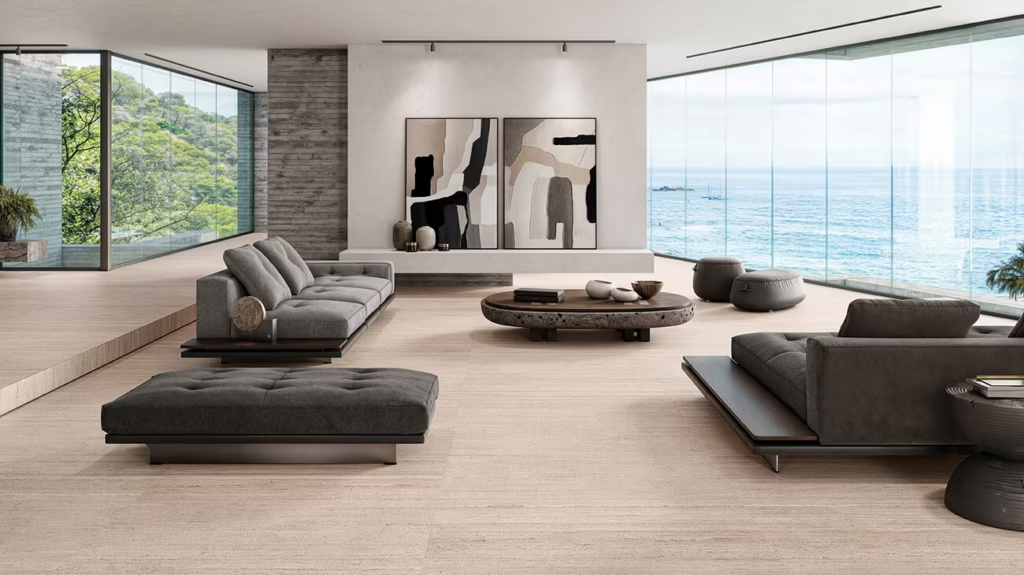
Travertine is often more expensive than basic ceramic tile but may cost less than some premium marble or specialty natural stone.
The tile price alone does not show the full cost.
Natural stone installation may require:
- More preparation
- More skilled labor
- Additional sealing
- Higher shipping costs
- More waste
- Specialized cutting
How Long Does Travertine Flooring Last?
Properly installed travertine can last for decades.
Its lifespan depends on:
- Structural stability
- Installation quality
- Maintenance
- Moisture control
- Traffic
- Cleaning habits
- Sealing
Natural stone can also be restored, filled, honed, or polished when necessary.
Can Travertine Be Refinished?
Yes, many travertine floors can be professionally restored.
Common restoration services include:
- Deep cleaning
- Hole filling
- Crack repair
- Honing
- Polishing
- Sealing
- Grout restoration
This can extend the life of the floor without full replacement.
Is Travertine Slippery?
Slip resistance depends on:
- Finish
- Surface texture
- Tile size
- Grout joints
- Water
- Sealer
- Cleaning residue
Polished travertine is generally smoother.
Tumbled, brushed, or textured travertine may offer more traction, but product-specific ratings still matter.
Is Travertine Good for Pets?
Travertine can work in homes with pets, but there are several concerns.
Potential issues include:
- Scratches from claws
- Acidic pet accidents
- Stains
- Slippery polished surfaces
- Grout discoloration
Choose a honed or textured finish, clean accidents quickly, and use area rugs in high-traffic pet zones.
Is Travertine Good for High-Traffic Areas?
Yes, with proper installation and maintenance.
For busy spaces, choose:
- Honed finish
- Filled surface
- Medium color
- Durable grout
- Effective entry mats
Very light polished tile may show wear and dirt more clearly.
Is Travertine Floor Tile Outdated?
Travertine is not inherently outdated.
Its appearance depends on:
- Color
- finish
- tile size
- grout
- layout
- surrounding materials
Small glossy beige tiles with heavy brown grout may look dated.
Large-format honed travertine with minimal grout can feel modern and refined.
How to Make Travertine Look Modern
Use:
- Large-format tile
- Narrow grout joints where appropriate
- Light matching grout
- Honed finish
- Simple straight layout
- Minimal color variation
- Modern lighting
- Clean-lined cabinetry
- Neutral walls
How to Make Travertine Look Rustic
Use:
- Tumbled finish
- Chiseled edges
- French pattern
- Wider grout joints
- Warm grout
- Wood beams
- Plaster walls
- Antique-style furniture
How to Choose Travertine Floor Tile
Before buying, ask the following questions:
- Is the tile approved for floors?
- Is it suitable for wet areas?
- Is it rated for exterior use?
- Is it freeze-thaw suitable?
- Is it filled or unfilled?
- What finish does it have?
- What color variation should I expect?
- Is it calibrated?
- What sealer is recommended?
- What cleaning products are safe?
- What grout joint is required?
- Is white mortar necessary?
- What slip rating is available?
- How much extra material should I order?
- Are matching trim and replacement tiles available?
Best Travertine Finish by Room
| Room | Recommended finish | Why |
| Kitchen | Honed and filled | Easier to clean |
| Living room | Honed or polished | Refined appearance |
| Bathroom floor | Honed or textured | Better wet-area practicality |
| Shower floor | Small textured mosaic | More grout joints and drainage |
| Entryway | Honed, brushed, or tumbled | Handles traffic well |
| Bedroom | Honed | Comfortable visual finish |
| Patio | Exterior-rated tumbled or brushed | Texture and weather suitability |
| Pool deck | Exterior-rated paver | Better thickness and outdoor performance |
When Travertine Is a Good Choice
Travertine may be right for you if:
- You want authentic natural stone.
- You appreciate variation.
- You prefer warm neutral colors.
- You are willing to seal the floor.
- You use stone-safe cleaners.
- You clean spills quickly.
- You want a surface that can age naturally.
- You accept moderate maintenance.
When to Choose Another Material
Travertine may not be ideal if:
- You want almost no maintenance.
- You frequently use acidic cleaners.
- You need a highly uniform floor.
- You do not want color variation.
- You need maximum stain resistance.
- You are installing in a poorly drained outdoor area.
- You want the easiest DIY installation.
- You prefer a low-cost flooring system.
In those situations, travertine-look porcelain may be a better choice.
Frequently Asked Questions
Yes. Honed and filled travertine works well in kitchens when sealed and cleaned properly. Acidic spills and oils should be removed quickly.
Most travertine floors benefit from a penetrating natural-stone sealer. The timing depends on traffic, porosity, finish, and product instructions.
No. Vinegar is acidic and can etch the stone.
No. Travertine is a type of limestone.
Some finishes can be slippery. Polished travertine is smoother, while honed, tumbled, and textured finishes may offer more grip.
Honed and filled travertine is one of the most practical choices for indoor floors because it is smooth, low-sheen, and easier to clean.
Common sizes include 12 × 12, 16 × 16, 18 × 18, 24 × 24, and 12 × 24 inches. French patterns are also popular.
Yes, but only products approved for exterior use should be installed outdoors. Check thickness, finish, drainage, and freeze-thaw suitability.
Yes. Cracking may result from substrate movement, poor mortar coverage, weak tiles, impact, or improper installation.
Filled travertine is easier to clean and more practical indoors. Unfilled travertine offers a rustic appearance but requires more maintenance.
It requires moderate care. Use pH-neutral cleaners, remove grit, wipe spills quickly, and reseal as needed.
Yes. Individual tiles may be replaced, and professional stone restoration can address holes, scratches, dullness, and some stains.
Yes. Travertine conducts heat well and works with properly installed radiant heating systems.
Natural stone may improve visual appeal and buyer perception, but value depends on installation quality, condition, local preferences, and the overall home.
Travertine can feel cool, especially in winter. Rugs or radiant floor heating can improve comfort.
Final Thoughts
Travertine floor tile is a durable and attractive natural-stone option for kitchens, bathrooms, living areas, entryways, patios, and selected outdoor spaces.
Its greatest strengths are its natural variation, warm colors, wide range of finishes, and timeless appearance. Its main disadvantages are porosity, acid sensitivity, sealing requirements, and more demanding installation.
For most indoor floors, honed and filled travertine offers the best balance of appearance and maintenance. Tumbled or brushed surfaces are better suited to rustic spaces and some exterior applications, while polished travertine is best reserved for dry or formal areas.
The right choice depends on the room, substrate, moisture conditions, finish, tile size, and the amount of maintenance you are willing to perform.
When installed correctly and cleaned with stone-safe products, travertine flooring can remain beautiful for decades.